Common Registration Assessment, Part 1
Volume to give: liquid medicine calculations
The most common Part 1 setup: a dose, a strength written as mg in some mL, and a volume to measure.
Published 4 October 2026. Independent revision material, not GPhC questions, not for patient care.
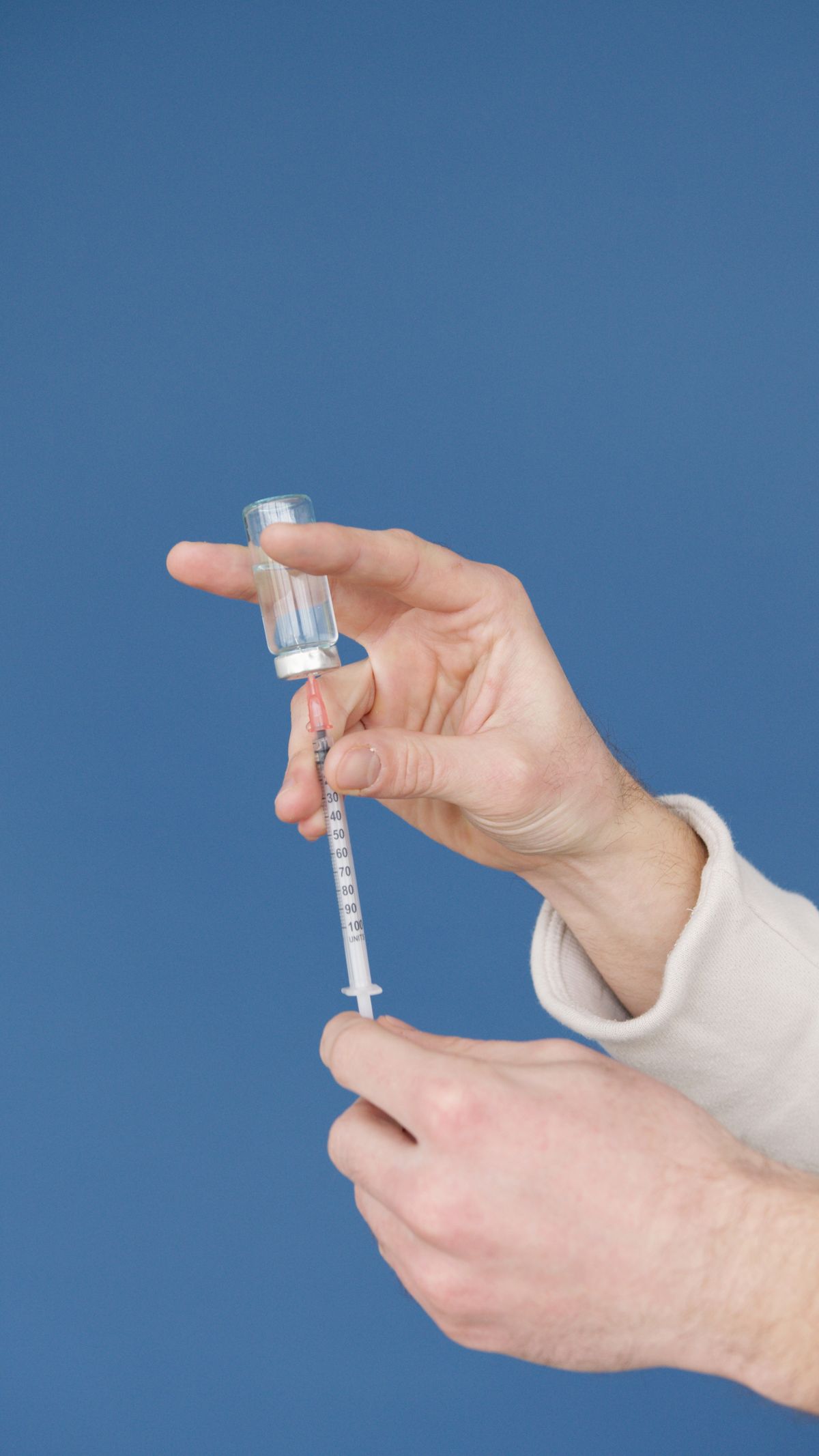
Liquid medicines are labelled as an amount in a volume, such as 125 mg in 5 mL. The first move is to turn that into one number per millilitre, because it makes every later step a single division.
Then check the units of the dose against the units of the strength before dividing. A dose in grams against a strength in milligrams is the standard trap.
The method
- Convert the strength to mg per mL.
- Convert the dose to the same unit as the strength.
- Divide the dose by mg per mL to get mL.
- Check the volume is a sensible amount to measure.
Three practice questions
Work each one on paper first, then open the answer. All drugs and patients are fictional.
Question 1
A patient needs 150 mg of a drug. The suspension is 250 mg in 5 mL. What volume do you measure?
Show the answer
Answer: 3 mL
Working: 150 ÷ 250 = 0.6, and 0.6 × 5 = 3 mL. As a check, 250 ÷ 5 = 50 mg/mL, and 150 ÷ 50 = 3 mL.
Question 2
The prescribed dose is 0.4 g. The solution contains 100 mg/mL. What volume is needed?
Show the answer
Answer: 4 mL
Working: 0.4 g = 400 mg. 400 ÷ 100 = 4 mL.
Question 3
A child is prescribed 60 mg. The elixir contains 15 mg in 5 mL. How many mL?
Show the answer
Answer: 20 mL
Working: 60 ÷ 15 = 4, and 4 × 5 = 20 mL.
Why the strength comes first
The Pharmaceutical Journal's GPhC-focused infusion article lists, among its learning aims, using a concentration expressed as % w/v to work out the required volume of a liquid medicine. The same habit applies to every liquid dose: get the strength into one clear figure per mL, then the volume is a single division.
Where marks are lost
- Dividing dose by the strength without scaling to the volume it is in (the 5 mL).
- Leaving grams and milligrams unconverted.
- Rounding to a volume that cannot be measured accurately.
Frequently asked questions
Should I convert to mg per mL first?
It is the safest route. 250 mg in 5 mL becomes 50 mg/mL, and the answer is dose ÷ 50.
Do I round the volume?
Follow the question. If it asks for the answer to one decimal place, do that, and keep full figures in the calculator until the last step.
Sources
- The Pharmaceutical Journal, medication maths: infusion rates (4 April 2025)
- GPhC, Common Registration Assessment specification and permitted items for 2026
The questions above are original and use fictional drugs. PreRegExamPrep is not affiliated with or endorsed by the General Pharmaceutical Council.
Practise until the method is automatic
Try 15 free questions with worked answers. No sign-up required.
More calculation topics
- Dose by weight calculations for the GPhC assessment
- Percentage strength calculations: w/v, w/w and ratios
- Dilution calculations with C1V1 = C2V2
- Infusion rate calculations in mL per hour
- Drip rate calculations: drops per minute
- Body surface area calculations
- Creatinine clearance (Cockcroft-Gault) calculations
- Moles and millimoles calculations
- Displacement volume calculations for reconstitution
See also the formula sheet, the eight sample questions and the approved calculator page.