Common Registration Assessment, Part 1
Displacement volume calculations for reconstitution
Three original reconstitution questions, each starting from the final volume.
Published 4 October 2026. Independent revision material, not GPhC questions, not for patient care.
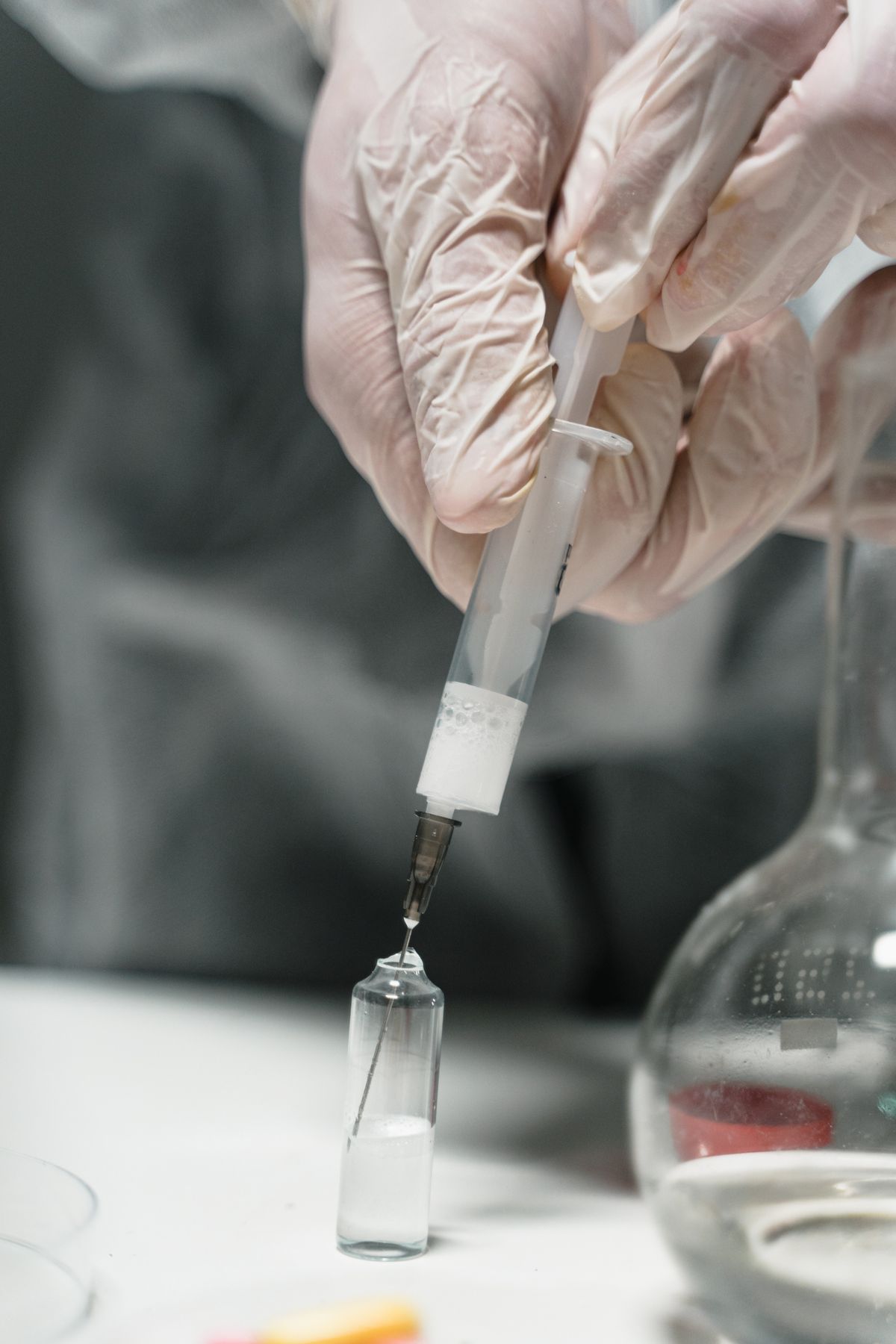
When a powder is dissolved, it takes up space. The final volume is the diluent you add plus the volume the powder displaces, and that final volume sets the concentration.
Sources quote displacement in different ways, sometimes as a volume for the whole vial and sometimes as the amount of powder that displaces 1 mL. Read which one you are given.
The method
- Work out the final volume: diluent plus displacement.
- Concentration = amount of drug ÷ final volume.
- For a target concentration: final volume = drug ÷ concentration; diluent = final volume − displacement.
- Volume of dose = dose ÷ concentration.
Three practice questions
Work each one on paper first, then open the answer. All drugs and patients are fictional.
Question 1
A 500 mg vial has a displacement volume of 0.3 mL. You add 4.7 mL of water for injection. What is the final concentration?
Show the answer
Answer: 100 mg/mL
Working: Final volume = 4.7 + 0.3 = 5 mL. 500 ÷ 5 = 100 mg/mL.
Question 2
1 g of powder displaces 0.8 mL. You want a concentration of 250 mg/mL. How much diluent do you add?
Show the answer
Answer: 3.2 mL
Working: Final volume = 1,000 ÷ 250 = 4 mL. Diluent = 4 − 0.8 = 3.2 mL.
Question 3
A 2 g vial displaces 0.8 mL and 9.2 mL of diluent is added. What volume contains a 500 mg dose?
Show the answer
Answer: 2.5 mL
Working: Final volume = 9.2 + 0.8 = 10 mL. 2,000 ÷ 10 = 200 mg/mL. 500 ÷ 200 = 2.5 mL.
Displacement in the literature
The Pharmaceutical Journal's article on displacement volumes and values explains how a powder's displacement changes the final volume and concentration. The pages here apply the same arithmetic, always starting from the final volume.
Where marks are lost
- Using the diluent volume as the final volume.
- Mixing up a displacement value with a displacement factor.
- Dropping the displacement entirely.
Frequently asked questions
Does displacement always matter?
It matters when the powder is a noticeable fraction of the final volume. If the question gives a value, use it.
What is a displacement factor?
The amount of powder that displaces 1 mL. Divide the mass by the factor to get the displacement volume.
Sources
- The Pharmaceutical Journal, medication maths: displacement volumes and values
- GPhC, Common Registration Assessment specification and permitted items for 2026
The questions above are original and use fictional drugs. PreRegExamPrep is not affiliated with or endorsed by the General Pharmaceutical Council.
Practise until the method is automatic
Try 15 free questions with worked answers. No sign-up required.
More calculation topics
- Dose by weight calculations for the GPhC assessment
- Volume to give: liquid medicine calculations
- Percentage strength calculations: w/v, w/w and ratios
- Dilution calculations with C1V1 = C2V2
- Infusion rate calculations in mL per hour
- Drip rate calculations: drops per minute
- Body surface area calculations
- Creatinine clearance (Cockcroft-Gault) calculations
- Moles and millimoles calculations
See also the formula sheet, the eight sample questions and the approved calculator page.