Common Registration Assessment, Part 1
Whole vials and ampoules to draw up
Practise working out how many vials or ampoules a dose needs and the volume to draw up, with three original worked questions.
Published 10 October 2026. Independent revision material, not GPhC questions, not for patient care.
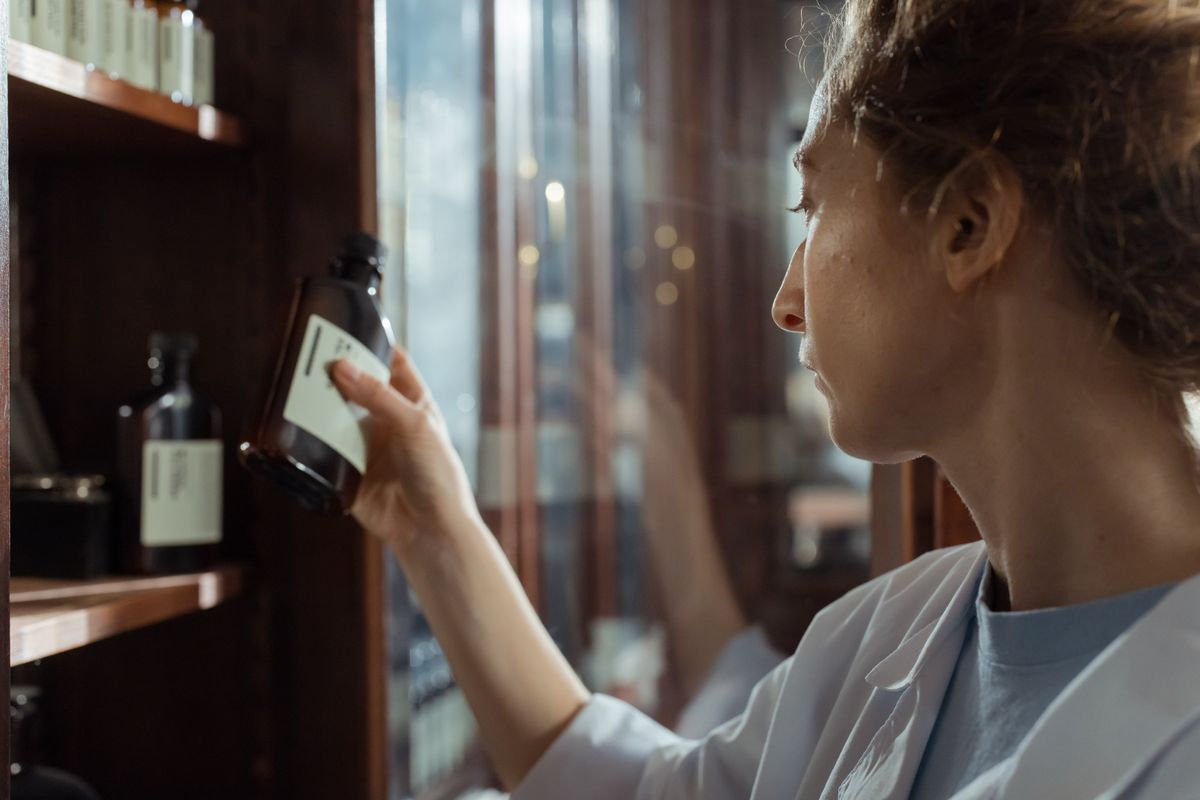
Injections come in fixed containers, so a dose can span more than one. The questions ask two things: how many containers must be opened, and what volume is actually drawn up and given.
The drawn volume uses the exact concentration; the container count rounds up, because you cannot open part of an ampoule. The examples are fictional and practise the counting and the volume separately.
The method
- Work out the volume needed from dose divided by concentration.
- Work out how many containers that volume spans, rounding up to a whole container.
- Keep the two answers distinct: containers opened and volume given.
- For a course, multiply the containers per dose by the number of doses.
- Check the concentration units before dividing, mg per mL or mg per container.
Three practice questions
Work each one on paper first, then open the answer. All drugs and patients are fictional.
Question 1
A fictional dose is 75 mg. Ampoules contain 50 mg in 2 mL. How many ampoules are opened and what volume is given?
Show the answer
Answer: 2 ampoules, 3 mL given
Working: Concentration = 50 mg in 2 mL = 25 mg/mL. Volume needed = 75 / 25 = 3 mL, which spans 2 ampoules of 2 mL.
Question 2
A fictional dose is 240 mg once daily for 7 days. Vials contain 100 mg in 5 mL. How many vials are needed for the course?
Show the answer
Answer: 21 vials
Working: Each dose needs 240 / 100 = 2.4 vials, so 3 vials are opened daily. Course total = 3 x 7 = 21 vials.
Question 3
A fictional dose is 1.8 g from vials of 600 mg, each reconstituted to 10 mL. How many vials and what total volume is drawn up?
Show the answer
Answer: 3 vials, 30 mL
Working: 1.8 g = 1800 mg. Vials needed = 1800 / 600 = 3. Volume = 3 x 10 = 30 mL.
Answer both parts
When a stem mentions containers, expect it to want the container count and the volume. Write both lines in your working even if only one is asked for.
Where marks are lost
- Rounding the drawn volume up to a whole container instead of keeping it exact.
- Rounding the container count down because the arithmetic gives a small fraction.
- Mixing mg and g when the vial content and the dose are in different units.
Frequently asked questions
Why round the container count up?
Because containers cannot be shared or divided before opening. A dose needing 2.4 vials uses the contents of 3 opened vials.
Is the leftover medicine wasted in the calculation?
Yes, for the exam you count whole containers opened. The question asks what is needed to give the dose, not what happens to the remainder.
Sources
- The Pharmaceutical Journal, medication maths: quantities to supply calculations
- The Pharmaceutical Journal, preparing for the GPhC pharmaceutical calculations assessment
- GPhC, 2026 assessment specification and permitted items
The questions above are original and use fictional drugs. PreRegExamPrep is not affiliated with or endorsed by the General Pharmaceutical Council.
Practise until the method is automatic
Try 15 free questions with worked answers. No sign-up required.
More calculation topics
- Dose by weight calculations for the GPhC assessment
- Volume to give: liquid medicine calculations
- Percentage strength calculations: w/v, w/w and ratios
- Dilution calculations with C1V1 = C2V2
- Infusion rate calculations in mL per hour
- Drip rate calculations: drops per minute
- Body surface area calculations
- Creatinine clearance (Cockcroft-Gault) calculations
- Moles and millimoles calculations
- Displacement volume calculations for reconstitution
- Quantity to supply calculations
- Using a provided formula in calculations
- Dose information from packaging and labels
- Diluting a stock to a lower strength
- Medicine cost and switch calculations
- Rounding rules in calculations
- Enteral feed rate calculations
- Electrolyte content over time
- Infusion dose per kg per hour
- Rounding doses to measurable volumes
- Relative risk and relative risk reduction
- Absolute risk reduction and number needed to treat
- Odds ratio and confidence intervals
- Relative versus absolute risk reduction
- Loading dose and volume of distribution
- Top-up doses from measured drug levels
- Salt correction factors
- Mass and molar drug concentrations
- Half-life and falling drug levels
- Steady-state concentration and infusion rate
- Bioavailability and equivalent oral doses
- Oral maintenance dose and dosing interval
- Elimination rate constant and half-life
- Accumulation towards steady state
- Ratio strengths and one in X
- Serial dilution factors
- Mixing solutions of different strengths
- Tablet quantities for reducing regimens
- Equivalent doses from provided conversion tables
- Thresholds and dose-banding algorithms
- Unit conversions for mass and volume
- Units and units per mL
- Reconstituting powders and final concentration
- Millimoles and milliequivalents
- Infusion time and volume remaining
- Days supply from pack sizes
- Percentage w/v and w/w conversions
- Ideal and adjusted body weight from formulae
- Diluting creams and ointments by weight
- Scaling a formula to a batch size
- Age-band doses from a provided table
- Tablet fractions and split doses
- Stones, pounds, inches and metric conversions
- Micrograms per minute from mg per hour
- Percentage change and mark-up
- Molar solutions and mass per volume
- Osmolarity from component concentrations
- Direct proportion and cross-multiplication
- Scientific notation and very small quantities
- Stock use and reorder quantities
- Parts per million and very dilute solutions
- Sodium chloride equivalents and isotonic solutions
- Density and specific gravity conversions
- Doses per day and hours between doses
- Finding the volume of diluent to add
- Capping a dose at a stated maximum
- Reading values from a provided graph
- Micrograms per kg per minute infusions
- Percentage composition of a compound preparation
See also the formula sheet, the eight sample questions and the approved calculator page.